
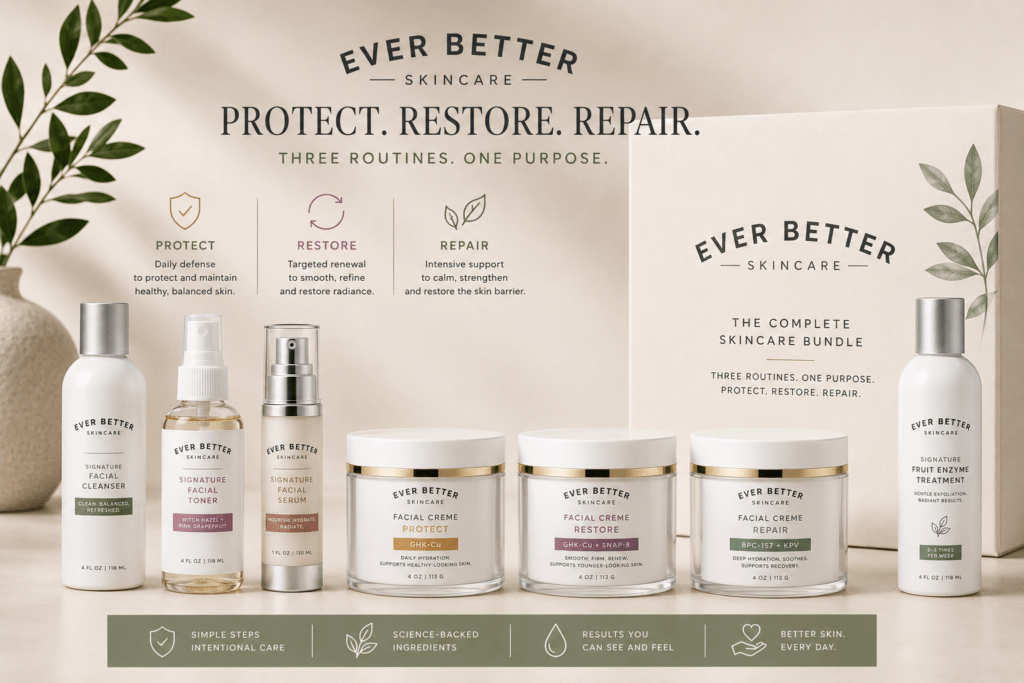
Scan the ingredient list on almost any moisturizer or serum today and you’ll likely spot both terms: “collagen peptides” and “copper peptide” (GHK-Cu). They’re often marketed side by side, but they are not interchangeable, they come from different places, work through different mechanisms, and are backed by very different bodies of research. Here’s how they actually compare.
What Are Collagen Peptides?
Collagen peptides (sometimes called hydrolyzed collagen) are fragments of collagen protein that have been broken down into smaller pieces so they can be used in skincare formulas (and, increasingly, in oral supplements). In a topical product, collagen peptides mainly function as humectants: they sit at the surface of the skin and help attract and hold onto moisture, in a role similar to hyaluronic acid.
Whole collagen molecules are far too large to pass through the skin’s outer barrier, and even broken-down collagen peptides remain relatively large. Because of this, topical collagen peptides are generally understood to act on the surface layer of skin rather than reaching the deeper layers where your body actually manufactures its own collagen.
What Is GHK-Cu?
GHK-Cu (copper peptide) is a naturally occurring tripeptide bound to a copper ion that your body produces in gradually decreasing amounts as you age. Unlike collagen peptides, GHK-Cu is a signal peptide: it doesn’t add structural material to the skin directly. Instead, it acts as a messenger, helping deliver copper to skin cells in a way that’s associated with supporting the skin’s own natural collagen and elastin production, alongside antioxidant and skin-recovery-supporting activity.
GHK-Cu is one of the most studied peptides in cosmetic science, with a formulation history spanning decades, including research into its role in skin repair and tissue remodeling.
How They Work: Side by Side
🧴 Collagen Peptides
- Type: Structural protein fragment
- How it works: Sits at the skin’s surface, attracting and holding moisture
- Depth of action: Primarily surface-level
- Best known for: Surface hydration and short-term smoothness
- Research history: Growing, especially for oral supplementation
🔶 GHK-Cu
- Type: Signal (carrier) peptide
- How it works: Signals skin cells to support their own natural processes
- Depth of action: Associated with activity beneath the surface layer
- Best known for: Supporting the appearance of firmness, tone, and overall skin vitality
- Research history: Extensive, decades of topical cosmetic and skin-recovery research
So Which One Is More Effective?
The honest answer: they’re not really solving the same problem, so “more effective” depends on what you’re trying to address.
If your main concern is surface dryness or short-term smoothness, a moisturizer built around collagen peptides can deliver a real, noticeable improvement in how skin looks and feels, much like any good humectant-based formula.
If your goal is supporting the skin’s own longer-term structural processes (the appearance of firmness, elasticity, and overall resilience) GHK-Cu has a substantially larger body of research behind it, and works through a fundamentally different, signal-based mechanism rather than surface hydration alone.
Why We Formulate With GHK-Cu
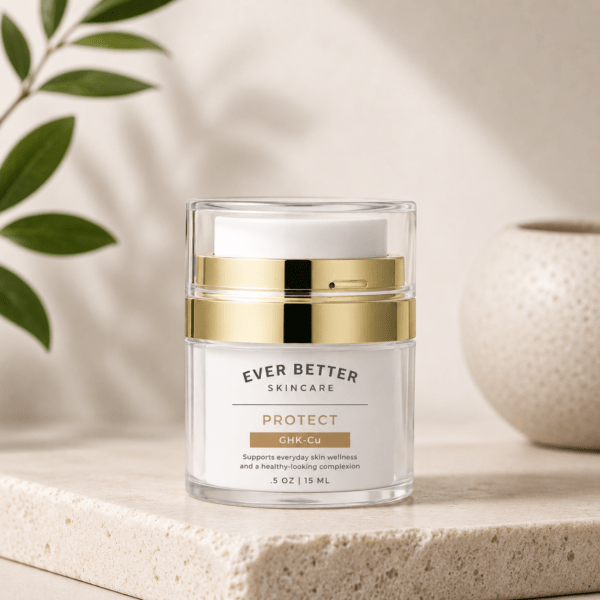
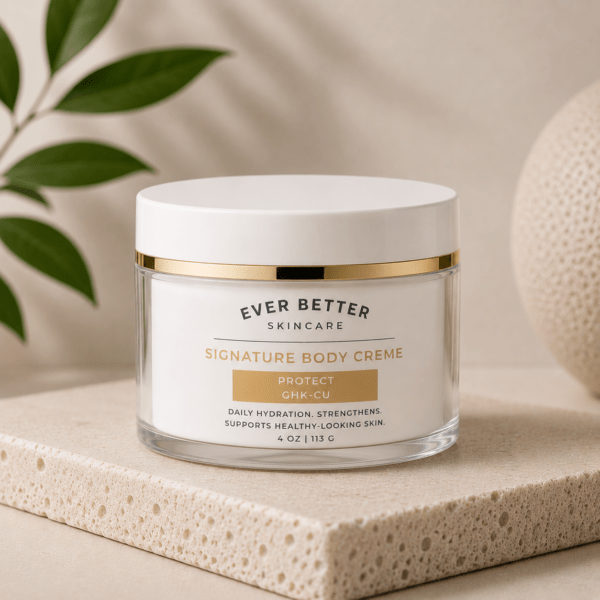
It’s why GHK-Cu is the foundation of our Protect and Restore formulas, across the Multi-Peptide Recovery Creme, Multi-Peptide Body Creme, and Complete Peptide System lines, we chose it specifically for its well-documented role in supporting the skin’s own natural processes, rather than relying on surface-level hydration alone to do the work.
Can You Use Both?
Yes, they’re not mutually exclusive. Many routines layer a lightweight, collagen-peptide-containing moisturizer for everyday surface hydration underneath a GHK-Cu treatment for longer-term support. Used together, one addresses how skin feels right now, while the other supports how it holds up over time.
Frequently Asked Questions
Is GHK-Cu safe to use every day?
Yes, GHK-Cu is generally considered gentle enough for daily use. As with any active ingredient, we recommend a patch test first if you have known sensitivities.
Do collagen peptides do anything, or is it just marketing?
Topical collagen peptides genuinely do function as effective humectants and can measurably improve surface hydration and smoothness, they’re just not delivering the same deeper, signal-based benefits as a peptide like GHK-Cu.
How long before I see results from GHK-Cu?
Because GHK-Cu works by supporting skin’s own gradual processes, most people look for changes in appearance over 4–8 weeks of consistent, daily use rather than overnight.
Which of your products contain GHK-Cu?
Our Protect formula (GHK-Cu alone) and Restore formula (GHK-Cu + Snap-8), available across the Multi-Peptide Recovery Creme, Multi-Peptide Body Creme, and Complete Peptide System collections.
Not sure which formula is right for your skin? Take our two-question quiz to find your routine.